Syrah and Shiraz: A Sensory Guide to What's Really in Your Glass
 Isabelle Lesschaeve
Syrah or Shiraz? Same grape, different styles. Discover its peppery aroma, why some people can't smell it, and how climate shapes the wine.
Is Syrah the same as Shiraz? Yes, and no.
It's the same grape, but the label name often hints at a style. In this guide, you'll learn what gives Syrah its signature pepper, why some people can't smell it at all, and how climate, harvest, and winemaking shape the wine you pour.
Syrah and Shiraz: One Grape, Two Names
Syrah and Shiraz are the same Vitis vinifera cultivar. For the genealogy fans, its parents are Dureza and Mondeuse Blanche.
The two names aren't only about geography (Northern Rhône for Syrah, Australia for Shiraz). Many winemakers use the name as a stylistic signal.
"Syrah" often suggests a cooler, more savory, peppery style. "Shiraz" often suggests something riper and more generous. But as you'll see, many factors decide the final style.
What About Petite Sirah?
Petite Sirah is not a lighter or small-berried Syrah. It's a separate variety, officially called Durif after the French botanist François Durif, who created it by crossing Syrah with Peloursin.
If anything, it's the opposite of light: deeply colored, dense, very high in tannins, quite astringent, and full of dark fruit. It deserves its own tasting, so we'll leave it aside here.
The Core Sensory Profile of Syrah
Appearance: Don't Let the Color Fool You
Young Syrah is purple to violet-ruby and often so opaque you can't see the bottom of the glass. As it ages, the anthocyanins (the pigments responsible for color) break down. The blue rim fades to ruby, then to garnet and brick, like any aged red.
Here's the trap. When we see a dark, opaque wine, our brain assumes it will dry up your palate with tannins and astringency.
That's a tasting bias, the logical bias more specifically, and it's often misleading.
A dark wine may not be very tannic, and a pale wine can be surprisingly grippy (Pinot Noir proves this regularly).
Tasting tip: Assess the wine with your nose and palate first. Look at the color at the end. Don't try to deduce quality from appearance. Check this video for more tips.
Aromas: Dark Fruit, Pepper, Meat, and Flowers
Syrah's aroma profile is wonderfully layered:
Dark fruit: blackberry, blueberry, plum
Spice: black pepper (the signature marker)
Savory: olive-type green notes, smoked meat
Floral: violet, lavender
The meaty, smoky character comes partly from sulfur compounds formed during winemaking and from volatile phenols.
A quick note on plum: it's one of the hardest aromas to train. A fresh plum has plenty of flavor in the mouth (retronasally) but very little when you simply smell it, which makes it challenging to find a good aroma standard.
Rotundone: The Molecule Behind the Pepper
Rotundone is the compound behind Syrah's peppery note. Researchers at the Australian Wine Research Institute identified it in wine relatively recently, in the 2000s.
What makes it fascinating:
It forms in the grape skins, is extracted during fermentation, and stays stable through maturation.
It loves cool conditions. Cooler temperatures and wetter seasons raise rotundone levels. Heat above about 25°C and heavy sun exposure after veraison (when grapes start to ripen) reduce it.
It varies within a single vineyard, so the peppery intensity of a wine is hard to predict.
It's extraordinarily potent. Its detection threshold in wine is 16 nanograms per liter. That's 0.000000016 grams per liter.
Why You Might Not Smell the Pepper
Research suggests that roughly 25 to 35% of people cannot detect rotundone at all. This is a specific anosmia, a genetic blind spot for one particular aroma.
If others find pepper in a Shiraz and you don't, this may be why.
There's nothing to fix. It's simply a genetic predisposition, and you can’t do anything about it.
Mouthfeel and Taste: An opportunity to build up your sensory repertoire
Syrah is generally dry and medium- to full-bodied. But a few terms in wine vocabulary deserve a closer look.
"High Tannin" Is a Deduction, Not a Perception
When someone says a wine is "high tannin," they're estimating a chemical concentration from what they feel.
What you actually perceive is dryness in your mouth.
It’s true that a strongly drying sensation is correlated with more tannins, which come from the skins and stems.
If you're early in your tasting journey, it's more useful to describe the texture of that sensation:
Silky or velvety?
Powdery or grainy?
Truly drying, making you want to salivate?
Body Is Fuzzier Than You Think
Light, medium, and full body are loosely defined terms. People often link body to alcohol and glycerol. Studies suggest some correlation between perceived fullness and ethanol, but not with glycerol, which contributes sweetness rather than viscosity.
I wrote more about wine body and what it means in this article.
Astringency vs. Bitterness
These two sensations get confused constantly:
Bitterness is a taste, perceived on the tongue, often at the back of the tongue or throat when you swallow. Think strong tea or dark-roasted coffee. In wine, it's usually not a desirable trait.
Astringency is a feeling: the drying, puckering sensation caused by tannins as discussed above.
Practicing this distinction will make your tasting notes far more precise.
What Shapes the Style: Four Profile Modifiers
1. Climate
Climate has the biggest impact on how Syrah tastes.
Climate | What you'll find |
|---|---|
Cool | Black pepper, violet, olive, and savory notes, stronger astringency |
Temperate | Balanced dark fruit, black cherry, licorice, a balance of acidity, flavor, and alcohol |
Warm | Ripe, jammy blackberry, chocolate, sweet spice, higher alcohol, lower acidity, fuller body |
Shopping tip: If you'd like less alcohol warmth and want to test whether you perceive pepper, look to the Northern Rhône or the Grampians in Australia. For the rich, ripe style, try Shiraz from the Barossa Valley or other warm inland sites.
2. Harvest Timing
Picking early brings more acidity and freshness, tart red and black fruit, and possibly green-seed tannins that add bitterness. Waiting longer brings riper, sugar-rich berries, higher potential alcohol, and a jammy character.
Growers and winemakers can’t always choose the ideal harvest timing, as bad weather often pushes them to act quickly to avoid losing crop quality.
3. Winemaking: Stems and Extraction
Winemakers choose whether to ferment with or without stems.
- Lignified stems (brown and woody) can add spice and a pleasant green freshness.
- Unripe green stems bring harsh green notes and drying astringency. Managing maceration before pressing is a balancing act.
4. Maturation: Oak and Oxygen
Two levers shape the wine during aging.
Oak barrels:
Neutral (previously used) barrels contribute little oak character.
New oak gives vanillin (vanilla), oak lactones (coconut), eugenol (clove), and guaiacol (smoky, meaty). Heavy oak can mask Syrah's floral notes.
Oxygen:
A reductive environment can build attractive roasted coffee and mocha notes, but too much brings faults like struck match, rubber, or garlic.
Too much oxygen risks oxidation and acetaldehyde, which smells like bruised apple. Nobody wants a Madeira-style Syrah.
Syrah in a Blend: Understanding GSM
You've probably seen "GSM" on a label. It's the classic Southern Rhône blend of Grenache, Syrah, and Mourvèdre, and each grape plays a role:
Grenache: red fruit (strawberry, red cherry) and a smoother mouthfeel
Syrah: dark fruit, violet, pepper (depending on the growing site), and structure
Mourvèdre: more tannin, earthy notes, and a longer finish
If you've never tasted a GSM, it's a fun blend to explore.
Set Up a Syrah Tasting Like a Sensory Scientist
Want to put this into practice? Here's a simple approach:
Choose your wines. Beginners, pick one. More experienced tasters, pick two contrasting styles, such as Northern Rhône vs. Barossa. Side-by-side tasting reveals nuances you'd miss with a single glass. Syrah from California, Washington State, or South Africa also makes a great single-wine tasting.
Know as little as possible about the wine before tasting it. Don't read the back label or download the tech sheet ahead of time. Let the wine speak, and your senses discover its flavor nuances.
Use the sensory tasting sheet to guide your sensory discovery. You can download yours here.
Connect afterwards. Once you've recorded your perceptions, read the technical details and link what you sensed to how the wine was made.
Don't make it too complicated.
The Syrah-Shiraz Sensory Profile Map
How about summarizing all this information on one infographic?
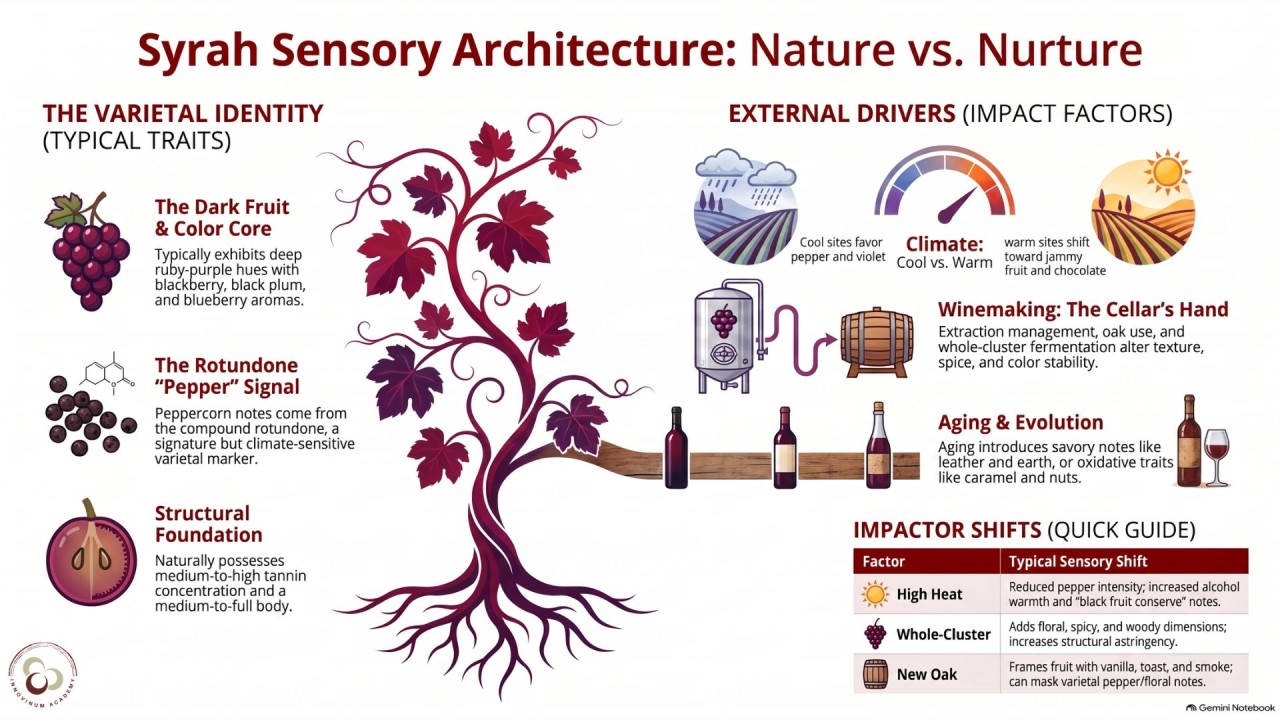
Use it to interpret your next Syrah tasting.
Ready to trust your senses?
If you've tried different approaches and still second-guess your aroma descriptions, book a free 45-minute session with me. Together we'll map out your personal sensory training roadmap, so you know exactly which steps to take next. Book your session here.
P.S. This post was adapted from a Syrah masterclass in the Curious Palates community on Skool, where we explore a grape each month and finish with a guided tasting together.
Useful literature
Geffroy, O., et al. (2020). May peppery wines be the spice of life? A review of the role
of rotundone in grape and wine aroma. OENO One, 54(2).
Australian Wine Research Institute. (2008). Consequences of extended maceration
for red wine colour, phenolic composition and sensory properties.
008-06-13-Final-Report-UA-05-03
van Leeuwen, C., et al. (2022). Aromatic maturity is a cornerstone of terroir
expression in red wines. OENO One, 56(2).
Categories: : Tasting education, wine style
Download your Free Resources

Unlock your senses | The Sensory Approach to Wine Tasting
Templates, audio guide to carry out a sensory training
Join Curious Palates, a FREE Community and open training space to develop your wine palate with sensory training

Isabelle Lesschaeve, PhD
Blog author, Wine Sensory Scientist and Wine Tasting Coach
Internationally renowned wine sensory scientist, Isabelle demystifies wine tasting and helps serious wine lovers improve their senses of smell and taste to sharpen their tasting skills and tasting notes.
InnoVinum LLC is a participant in the Amazon Services LLC Associates Program, an affiliate advertising program designed to provide means for sites to earn advertising fees through advertising and linking to amazon.com.