The Four-Aroma Ceiling: Why You Need to Stop Stressing Over Wine Tasting Notes
 Isabelle Lesschaeve
Decades of research reveal why your brain caps aroma identification at 4, why trusting your own palate is the key to enjoying wine & understanding it
The Hard Truth About Your Glass (and Your Nose)
Have you ever sniffed a glass of wine, looked at the tasting grid or the expert's tasting note listing black cherry, violet, forest floor, vanilla, and leather, and wondered why you could only smell generic fruit?
If you have ever doubted your palate or assumed you have a "weak nose," know that struggling to find words to put on what you sense is absolutely normal.
Most wine lovers and ambitious students second-guess their perceptions because traditional wine education teaches them to memorize expert, foreign vocabulary instead of training their senses to be more discerning.
Here is the hard scientific truth: the human brain cannot reliably identify more than three or four aromas in a mixture at once. This is not a personal shortcoming or a lack of effort; it is a fundamental biological limit of human olfactory processing.
As a wine tasting coach with over 30 years of experience in sensory and consumer science, my mission is to demystify wine tasting rituals and empower you to trust what you sense.
Learning to taste should be fun, not intimidating.
As a taster, you need to understand the sensory instruments you’re dealing with, your nose and taste buds, and how your brain is processing the sensations you detect in a glass of wine.
Below, you’ll discover a sensory limitation most advanced wine tasters ignore.
The Science: From the Early Demonstration to Sommelier Brains
Peer-reviewed research over three decades has confirmed the science behind this olfactory limit.
The landmark study by Laing and Francis in 1989 tested 123 healthy, untrained participants to see how many components they could identify in a mixture.
- First, participants were trained to recognize seven familiar single odors: citrus, pine, mint, clove, licorice, vinegar, and almond.
- Then, the researchers created blinded mixtures ranging from simple pairs to complex blends of up to seven components.
The results were astonishing.
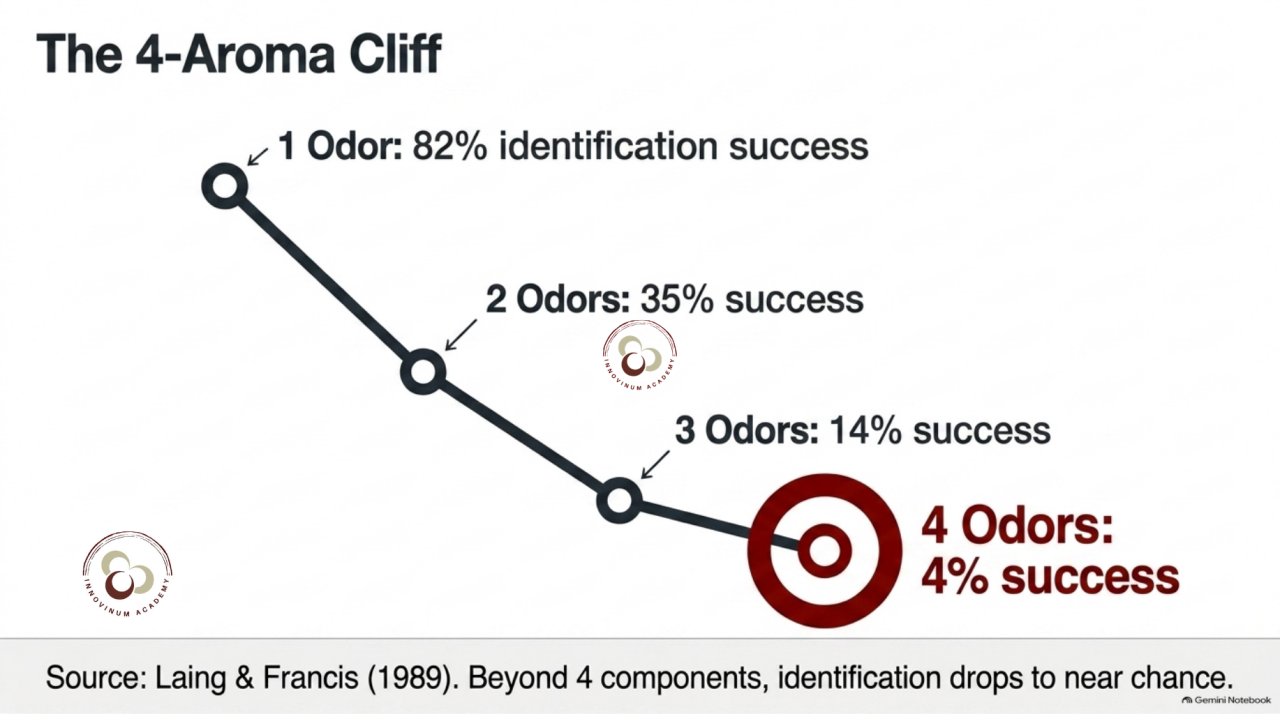
When participants smelled a single odor blind, they identified it correctly 82% of the time. But when two odors were mixed together, accurate identification dropped dramatically to 35%. For three-aroma mixtures, accuracy plummeted to 14%. And when presented with a mixture of four aromas, only 4% of participants could correctly identify all individual components.
You might wonder: do experienced wine experts or sommeliers have superior biological abilities that let them bypass this ceiling?
A 2018 study by Sinding and collaborators put this exact question to the test by comparing untrained novices with experienced sommeliers using complex odor mixtures.
The findings put an end to the myth of the "super-nose".
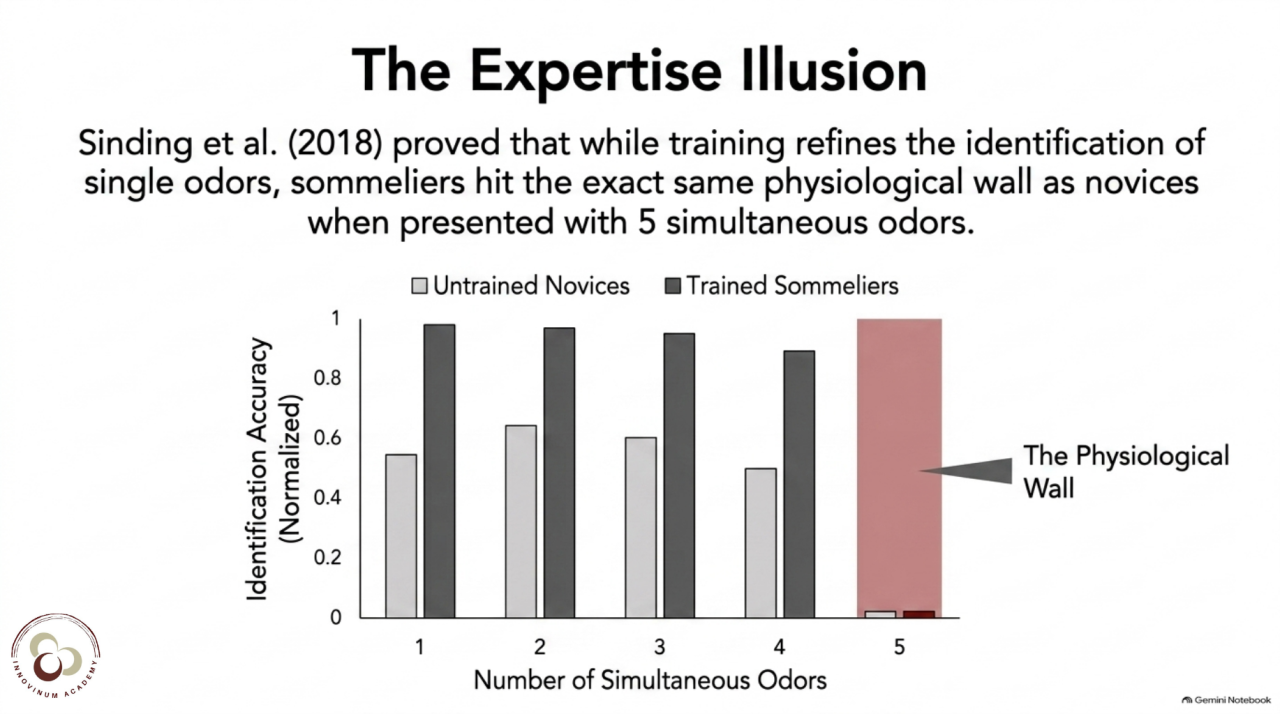
While sommeliers performed significantly better at identifying single-, double-, triple-, and four-component mixtures because of their trained vocabulary and sensory memory, when presented with a five-component mixture, expert accuracy dropped to virtually zero.
Sommeliers hit the exact same biological wall as novices. Experts do not have lower detection thresholds or superior physical noses; rather, sensory training allows them to label their perceptions up to that four-aroma limit with greater consistency.
Beyond four or five aromas in a blend, human physiology simply draws the line.
Elemental vs. Configural Processing: The "Wine Smell Gestalt"
Why does our brain stop dividing aromas once a mixture grows complex? The answer lies in how the brain interprets sensory information through two distinct modes: elemental processing and configural processing.
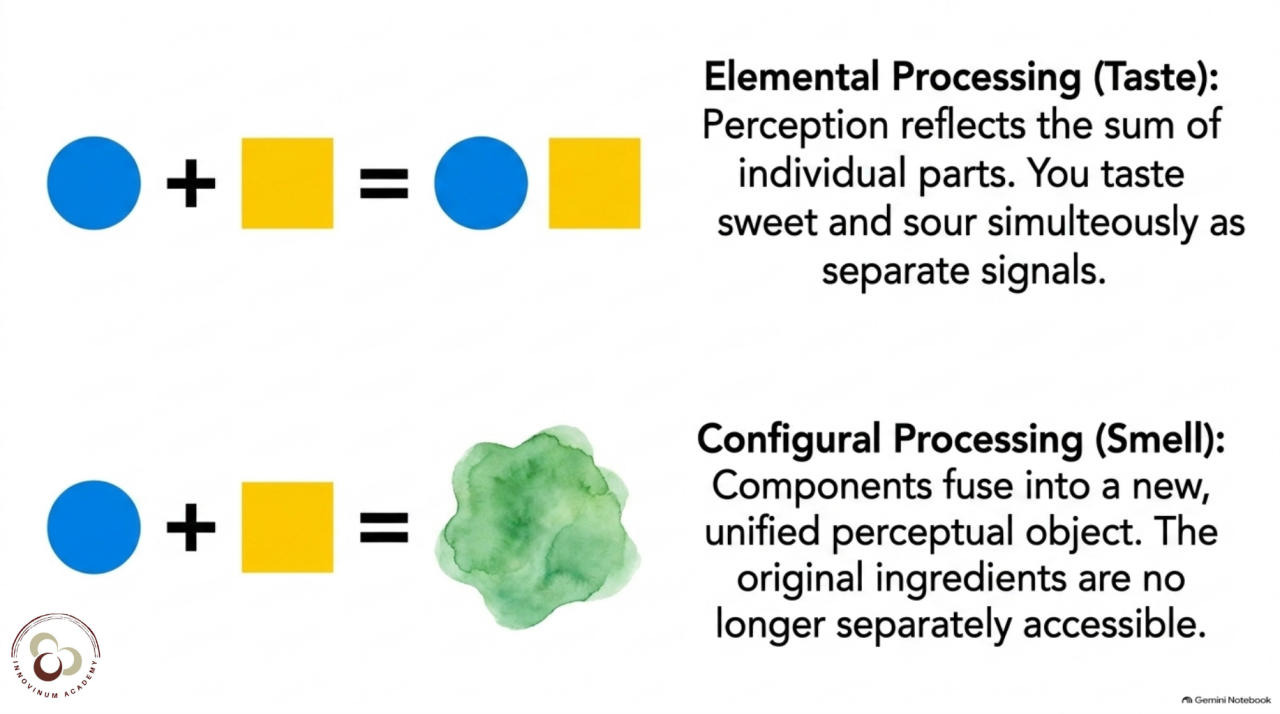
In elemental processing, the brain perceives individual components side-by-side as a sum of individual parts.
This happens frequently with taste perceptions on the tongue, where you can easily sense sweetness and acidity simultaneously. However, for most aroma compounds traveling through our nose, our brain relies on configural processing.
In configural processing, individual aroma compounds tend to fuse into a brand-new, unified perceptual object.
You perceive the synthesis of the parts, but you can no longer break down the original ingredients.
Think of a fresh strawberry. The signature strawberry aroma is actually a fusion of five distinct chemical compounds. Smelled individually, none of those five compounds smells like strawberry—their individual profiles range from fresh green grass to spicy or honey. Yet when your brain encounters them together, it integrates them into a single sensory experience: fresh strawberry.
A single glass of wine contains close to a thousand volatile aroma compounds. While certain signature markers can spike and remain distinct—such as methoxypyrazines in Cabernet Sauvignon, volatile thiols in Sauvignon Blanc, or rotundone in Syrah—these identifiable single spikes are the exception, not the rule.
Most of what you smell in wine is a wine smell gestalt: a harmonious fusion created when your brain synthesizes hundreds of signals into an integrated sensory snapshot.
And what about that widely cited 2014 study claiming humans can discriminate trillions of smells? Headlines aside, that research measured theoretical discrimination—our ability to distinguish aroma A from aroma B—not our practical cognitive ability to isolate and identify individual components inside a blend.
What About these Long Wine Tasting Notes?
If human biology caps simultaneous aroma identification at four components, why do wine back-labels, sommelier reviews, and WSET exam grids feature long, winding lists of aroma descriptors?
As Dr. Gordon Shepherd, author of Neuroenology, explains, long tasting notes do not represent separate simultaneous aroma objects, but rather clusters of near-synonyms used to describe a single integrated perception. When a taster writes "blackberry, cassis, black cherry, and violet," they are often using multiple words to capture the nuance of one complex, synthetic sensory gestalt.
Furthermore, a lengthy tasting note often results from a long tasting session. As a wine opens up and warms in the glass over time, new aromas surface in successive waves. But in any single moment, your brain is processing only a handful of sensory markers.
So take your time to let the wine speak. Don't rush!
Reframe Your Palate: How to Let the Wine Speak
Knowing that every human operates under this biological ceiling should be a huge relief. You do not need to memorize textbook descriptions or force yourself to list fifteen obscure descriptors to prove you appreciate fine wine.
Sensory training is not about altering your biology or acquiring pretentious vocabulary.
- It is about building a precise sensory repertoire and shifting your mindset.
- It is about learning to label what you perceive accurately so you can identify key varietal wine markers, understand a winemaker's intent, and evaluate a wine's structure with confidence.
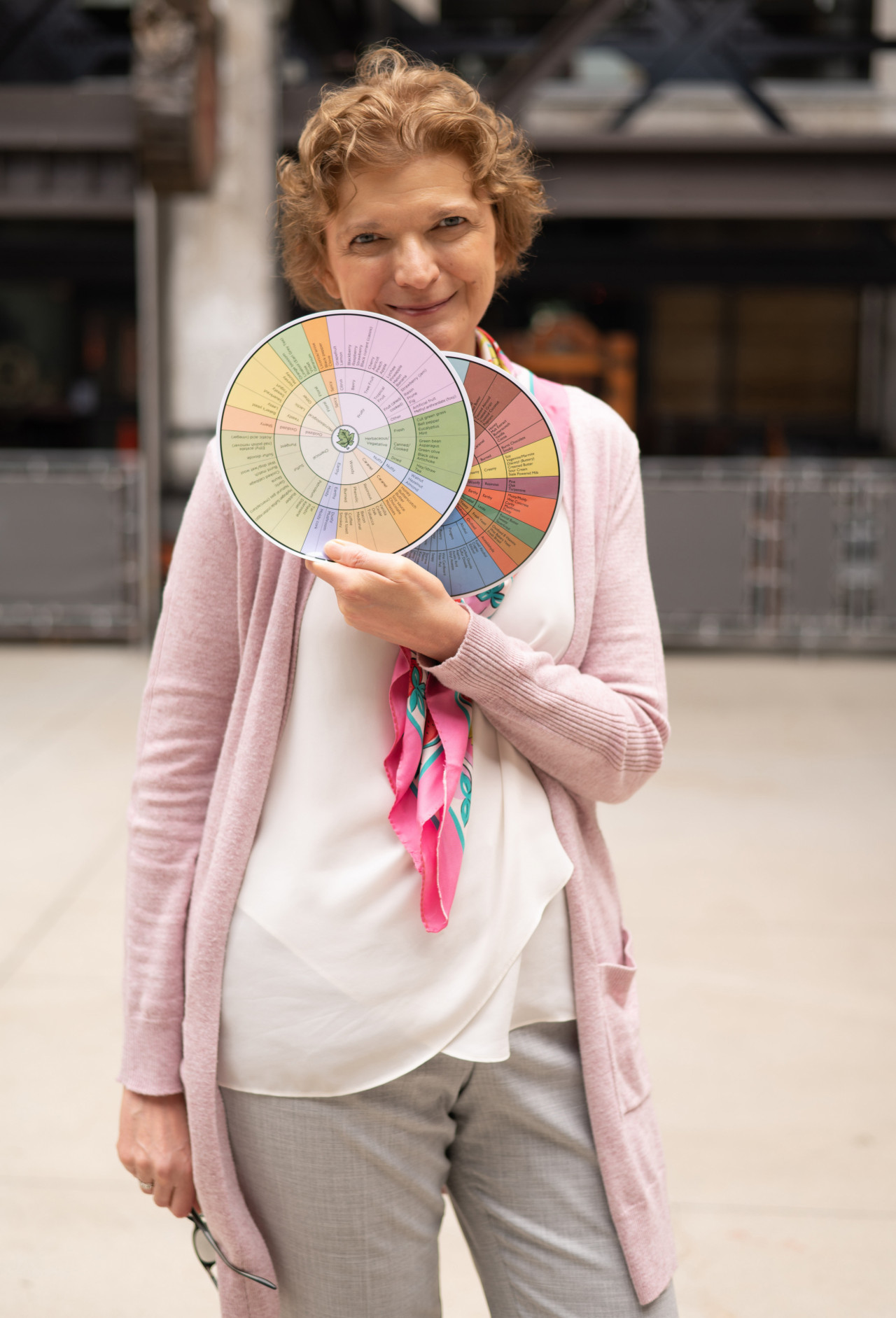
Rooted in the legacy of the Wine Aroma Wheel and over three decades of applied sensory research, my coaching programs put the taster—not the textbook—at the center of tasting. Plain words, used mindfully, are more than enough to communicate what is in your glass.
So the next time you pour a glass, pause, take a breath, and give yourself permission to stop hunting for expected aromas.
Trust your senses, speak in your own words, and let the wine speak.
Struggling to put words on what you sense?
Need help creating a clear sensory training roadmap to enhance your aroma description skills? Schedule a free 15-minute call to clearly identify your next steps.
References
Laing DG, Francis GW. The capacity of humans to identify odors in mixtures. Physiol Behav. 1989 Nov;46(5):809-14. PMID: 2628992.
Shepherd, GM. NEUROENOLOGY - How the Brain Creates the Taste of Wine. Columbia University. 2017. Press Publishers Since 1893 New York Chichester, West Sussex
Bushdid C, Magnasco MO, Vosshall LB, Keller A. Humans can discriminate more than 1 trillion olfactory stimuli. Science. 2014. 343:1370–1372.
Categories: : Tasting education
Download your Free Resources

Unlock your senses | The Sensory Approach to Wine Tasting
Templates, audio guide to carry out a sensory training
Join Curious Palates, a FREE Community and open training space to develop your wine palate with sensory training

Isabelle Lesschaeve, PhD
Blog author, Wine Sensory Scientist and Wine Tasting Coach
Internationally renowned wine sensory scientist, Isabelle demystifies wine tasting and helps serious wine lovers improve their senses of smell and taste to sharpen their tasting skills and tasting notes.
InnoVinum LLC is a participant in the Amazon Services LLC Associates Program, an affiliate advertising program designed to provide means for sites to earn advertising fees through advertising and linking to amazon.com.