Sensory Qualities of Chardonnay
 Isabelle Lesschaeve
Deepen Your Understanding and Enjoyment of Chardonnay Wines using a Science-driven Sensory Practice
Chardonnay: A Chameleon Wine
For many wine lovers, Chardonnay evokes strong feelings—sometimes even a love-hate relationship. But what truly makes this varietal wine so versatile and widely debated? This is what was at the center of a sensory class [1] hosted by Dr. Isabelle Lesschaeve.
Attendees took a deep dive into the world of Chardonnay, exploring its fundamentals, stylistic diversity, and how to sharpen tasting skills through targeted sensory practice.
The class content was built on the review of 48 research articles to ensure data reliability. Whether you’re a curious enthusiast or a wine student, this comprehensive summary captures the key lessons shared during the class and provides a roadmap for developing a more discerning wine palate.
Core Characteristics of Chardonnay
Chardonnay is famously known for its chameleon-like ability to express a vast range of styles. Unlike highly aromatic grapes such as Muscat or Gewürztraminer, Chardonnay presents a neutral sensory profile, allowing external influences and winemaking choices to take the spotlight and shape it to a desired state.
From Color to Structure
- Color: In cool climates, Chardonnay tends to display pale yellow hues, while warmer climates and the use of oak barrels can deepen its gold color.
- Aroma Spectrum: Expect cooler regions to bring green apple and lemon notes, associated with higher perceived acidity. Warmer regions evoke stone fruits like peaches or tropical aromas like pineapple and mango. These differences are underpinned by compounds like esters, lactones, and norisoprenoids.
- Structure and Texture: Chardonnay is generally low in tannins, so it lacks the astringency often found in red wines. Its acidity provides a crisp, mouthwatering sensation; as acidity drops (or as certain winemaking techniques are applied), the wine evolves into a softer, sometimes creamy or even oily texture.
Five Winemaking Levers Shaping Chardonnay’s Style
No grape is more revealing of winemaking choices than Chardonnay. Literature identified five primary “levers” winemakers use to shape the wine sensory profile :
1. Climate and Harvest Timing: Cool climates and early harvests retain acidity and yield fresher fruit flavors; warm climates and late harvests drive riper, more tropical expressions.
2. Malolactic Fermentation: This secondary fermentation converts sharper malic acid into softer lactic acid, often resulting in a creamy texture and “buttery” aromas caused by diacetyl. Contrary to popular belief, these buttery notes come from fermentation, not oak.
3. Oak Influence: Aging Chardonnay wine in oak barrels or with oak adjuncts imparts not just vanilla and spicy aromas but also alters the wine’s mouthfeel, adding fullness and textural complexity.
4. Lees Aging: Allowing Chardonnay to rest on its spent yeast cells (lees), mixed through bâtonnage, extracts additional flavors and creaminess.
5. Oxygen Management: Approaches range from highly reductive (minimal oxygen exposure, yielding flinty notes) to oxidative (controlled air contact, creating aromas of baked fruits, honey, or brioche).
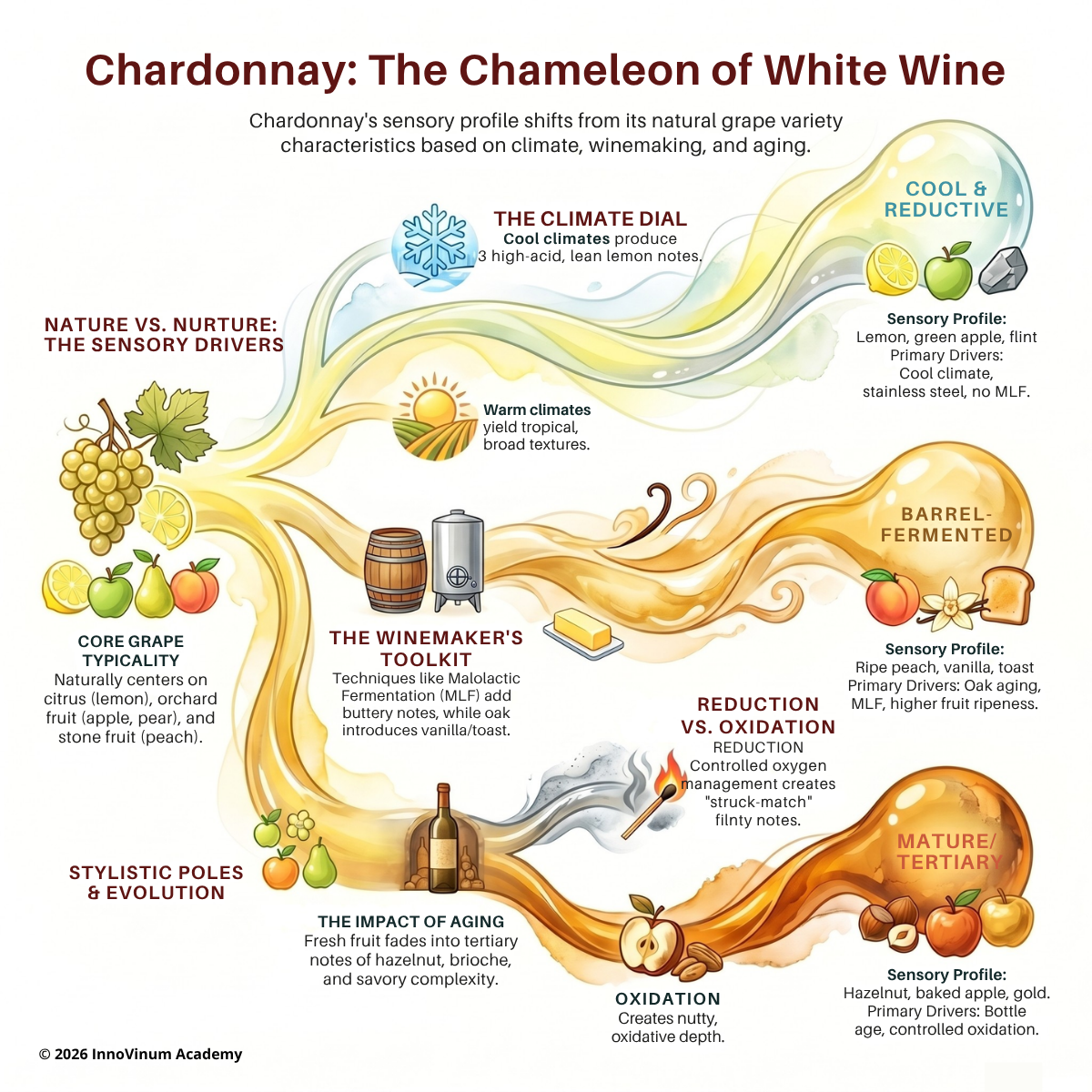
This “toolkit” allows Chardonnay to span a sensory continuum—from steely, mineral-driven wines to rich, lush, and opulent styles.
Mapping Chardonnay’s Sensory Landscape
Research categorized these diverse sensory profiles into four quadrants based on climate and winemaking choices. Each quadrant is characterized by typical aromas (e.g. green apple, flint, peach, vanilla, dried fruit, etc.) and corresponding texture (from unidimensional and saline to creamy and savory).
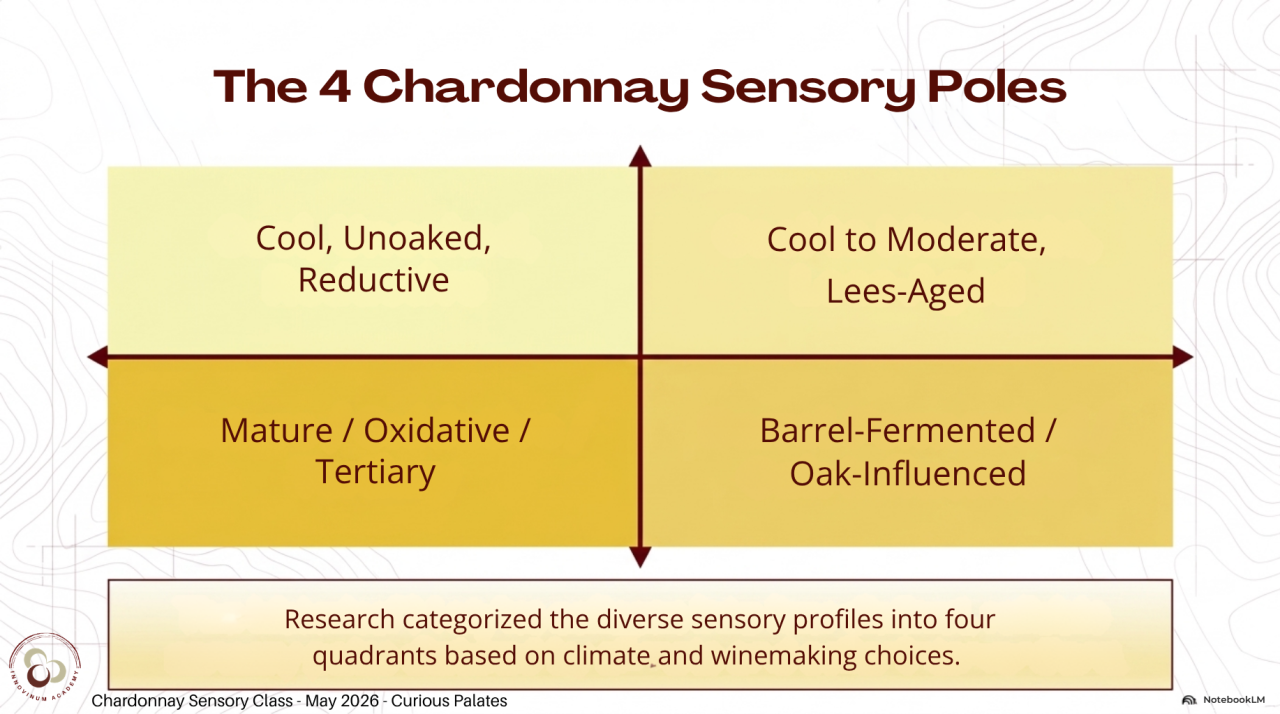
The practical takeaway: these quadrants align closely with varied consumer preferences. Therefore, understanding this map and associated sensory descriptions arms you with the vocabulary and frameworks to recognize and seek out your favorite Chardonnay styles.
How to leverage this map to develop a discerning wine palate?
The Power and Purpose of Sensory Practice
Whenever they teach about a wine style, most wine educators dump a lot of information, data, and long lists of descriptors on their students, asking them to memorize it all so they can recite it whenever they taste a wine of that style.
Learning about wine through sensory practice is different.
Rather than simply memorizing descriptors, the focus is on training your senses - especially your sense of smell - to recognize typical aromas, tastes, or mouthfeel, memorize them, and train your brain to recall them quickly when perceived in a glass of wine.
Therefore, this method builds wine knowledge through tasting, from the bottom up, versus building knowledge to taste, a top-down teaching process.
My motto is:
Structured sensory practice is the most effective way to develop a discerning wine palate.
This approach encourages participants to actively smell, taste, and interpret sensations, ultimately empowering them to identify and articulate their wine preferences and tasting notes with confidence
Building Your Own Sensory Practice
Here’s the step-by-step approach for sensory practice carried out inside the Curious Palates community :
1. Choose your Sensory Focus: Beginners are encouraged to select 3–6 sensory contrasting descriptors from the 4 sensory quadrants of the Chardonnay landscape. For example, green apple, yogurt, peach, vanilla, or dried fruit.
2. Familiarize your Senses with each Descriptor using Product References: Use real apples, yogurt, etc., to train your nose and palate. Repetition and focused attention help memorize these sensations and your interpretations.
3. For an Advanced Sensory Practice: Infuse product references in wine to mimic how these aromas and flavors may be expressed in a wine context.
4. Guided Tasting: Finally, apply your practiced senses to real wines, focusing on description rather than “correct” answers. Use your product references to validate your perceptions, not your instructor's tasting notes.
Because your perceptions are always right.
This framework can be adapted based on your level, time, and ambition.
Final Thoughts
Chardonnay’s diversity can be intimidating, but even beginners gain confidence and enjoyment by following a sensory practice with intention.
- After one week of sensory practice, you start unlocking your senses.
- After one month, you start writing more detailed tasting notes.
- After 3 months, you speak confidently about your perceptions when tasting wine.
Finally, if you don’t like a certain style of Chardonnay, that’s okay. A 2001 consumer study revealed 4 groups of wine drinkers with very different preferences for the 4 main sensory styles of Chardonnay [2].
Know that your preferences are valid, and understanding the reasons behind your likes and dislikes is not only empowering but makes wine shopping and enjoyment infinitely more rewarding.
Whether you prefer a crisp, citrusy cool-climate Chardonnay or a lush, buttery version, insights from this article will help you identify, articulate, and share your unique palate with confidence.
Go deeper into your understanding of Chardonnay and access the class materials and recording here.
You will get additional tools and tips to pursue your sensory journey on your own or by joining the Curious Palates community [3].
Resources
[1] Enhance your Chardonnay understanding by watching the sensory class: Chardonnay wine styles - A deep dive into Chardonnay sensory qualities
[2] I. Lesschaeve; L.N. Norris; T.H. Lee. In proceedings of the 11th AWITC 2001, R. J.
Blair, P. J. Williams, P. B. Høj (eds) 2002, Adelaide, SA, pp. 118-122.
[3] Learn about wine through sensory practice in the Curious Palates Community.
Categories: : Blog
Download your Free Resources

Unlock your senses | The Sensory Approach to Wine Tasting
Templates, audio guide to carry out a sensory training
Join Curious Palates, a FREE Community and open training space to develop your wine palate with sensory training

Isabelle Lesschaeve, PhD
Blog author, Wine Sensory Scientist and Wine Tasting Coach
Internationally renowned wine sensory scientist, Isabelle demystifies wine tasting and helps serious wine lovers improve their senses of smell and taste to sharpen their tasting skills and tasting notes.
InnoVinum LLC is a participant in the Amazon Services LLC Associates Program, an affiliate advertising program designed to provide means for sites to earn advertising fees through advertising and linking to amazon.com.