Is WSET Worth It? A Master of Wine on Wine Certifications, Sacrifice, and What's Missing
 Isabelle Lesschaeve


Is WSET worth it? Master of Wine Anne McHale explains what each level demands, how far to go, and the tasting skill certifications often miss.
Should I start a wine certification?
It's one of the first questions people ask me when they want to improve their palate and know more about wine.
So I invited someone who has climbed the whole ladder. Anne McHale is an award-winning Master of Wine based in London, a wine communicator, and the founder of Diploma Therapy, where she coaches WSET Diploma students.
She joined us for a fireside chat inside the Curious Palates community, and her answers were honest, practical, and sometimes surprising.
Here's what she shared.
From a student wine society to the Master of Wine
Anne grew up in a wine-loving family. Her father founded the first student wine society at Queen's University in Belfast, at a time when hardly anyone in Northern Ireland drank wine. When Anne went to Cambridge, the wine society was the first one she joined.
A wine career wasn't the plan. After studying French, she moved to London and applied for jobs that needed a French speaker. The first offer came from Mistral Wines, a small importer representing Rhône and Provence estates. Getting WSET qualifications was part of the job, so she started evening classes.
"I got the bug," she told us. Her next employer sponsored her Diploma, and later sponsored her Master of Wine, which she earned in 2013.
What a wine certification gives you that casual tastings don't
For Anne, the biggest reward was structure. Dropping into a class here and a tasting there doesn't add up the same way.
Because there's an exam at the end, you're pushed to actually learn the material. Whatever level you stop at, you leave with a solid overview of the key grape varieties and regions.
She described it as having her own mental database to draw on every time she stood in front of a wine shop shelf.
WSET Level 2 vs Level 3: how far should you go?
Since WSET Level 2 gives a solid wine foundation, why should anyone go beyond Level 2?
Anne stressed that the answer depends on how deep one wants to go. Level 2 is a great qualification for an interested amateur. (Her husband took it so he could access her special wine fridge, and he's happily stopped there.)
Level 3 makes sense if you want:
More depth on how wine is made
More detail on each key region
Blind tasting practice, since Level 3 includes a tasting exam while Level 2 is multiple choice only
If you're aiming for a career in wine, you'll need to keep going.
The missing piece: learning how to taste
After one of my classes, Anne said something that stuck with me: "I wish I had met you 12 years ago."
In WSET classes, the instructors assume you already know what raspberry or earth smells like in a wine. They list aromas, and many students think, "I can just smell wine." So they write the words down and learn which descriptors tend to appear together.
Full-bodied red with high alcohol? Probably vanilla and blackberry.
It's a tactical approach, not a sensory one.
What's missing is going back to the building blocks: training your nose and palate so you actually recognize what's in the glass. As Anne put it, it's never too late to go back to basics.
This is exactly what I (Isabelle) teach in the Wine Tasting Confidence Accelerator program: unlock your senses, develop your palate through sensory training, and build confidence in what you sense in each glass.
<<Get your free sensory training roadmap here.>>
The Diploma and the MW: be ready for sacrifice
Anne's advice for anyone starting the WSET path: take it one level at a time, and know that each step up asks more of you.
Level 3 is a real jump from Level 2. Expect to give up some free time and social life.
Level 4 (the Diploma) is a two-year course. The people around you may have to make sacrifices too.
The D3 unit, nicknamed "the beast," comes with a 600-page textbook, 12 wines tasted blind in the exam, and 50% of the overall qualification.
That's why she named her coaching membership Diploma Therapy. Passing at this level takes psychological fitness, especially alongside a full-time job or a family. She helps students break down the workload, study efficiently, and answer exam questions strategically instead of dumping everything they know.
And the Master of Wine? After two years of Diploma study in her 20s, Anne took a year off to enjoy London before signing up for five more years of study. Only a small share of people who start the MW finish it, around 5 to 10% by her estimate.
Why do it? The kudos, the independence it gave her as an educator, and the incredible network of friends you develop.
Why the Master of Wine tastes blind differently
In the MW exam, the blind tasting was the hardest part for Anne. Candidates taste 36 wines across three papers, with about 10 minutes per wine to write a full page.
You still use the same observations you learned at WSET: acidity, body, oak, quality. But you don't simply march through appearance, nose, palate, and conclusion.
Instead, you build an argument tailored to the question.
If you're asked for the origin of a white Burgundy, you start with your strongest evidence (it's Chardonnay), rule out California and Australia, then argue for the Côte de Beaune. Some questions ask you to weave evidence from three wines together. Others play mind games, like six wines each from a different country, forcing you to go back and re-taste when your conclusions collide.
The theory side is just as demanding. There's no textbook: every answer needs real examples from specific producers, across regions, price points, and styles. That means visiting winemakers, bottling plants, brand managers, and export directors, and even exploring the legal, political, and social sides of wine.
Do wine qualifications help your career?
Anne was candid. It depends on the role. Selling and communicating can be worth as much as knowledge. But those letters on your LinkedIn profile instantly signal competence, so you don't have to prove yourself from scratch.
You'll never be disadvantaged by having them.
Is memorizing wine knowledge still worth it in the age of AI?
Anne sees more students asking why they should memorize anything when AI can answer in seconds. Her view: at Diploma level, it's less about memorizing and more about applying knowledge to answer a specific question. That same skill is what lets us guide AI well.
I'd add that your experience is the part no tool can replicate. The winemakers you meet, the regions you visit, and the market you understand all shape your judgment.
Anne agreed. As more becomes automated, people will crave human connection, like a sommelier sharing a personal story from a winery visit.
Switching off the analytical brain
So how does a Master of Wine simply enjoy a glass?
"I just activate Irish Anne," she laughed.
She loves Come Over October because it celebrates wine the way she enjoys it: with good food and good friends. When she opens a special bottle, she skips the technical notes and shares the story instead, like the bottles she helped make during a vintage in Stellenbosch.
On the industry's current contraction, she pointed to younger drinkers being more health-conscious, and to other drinks doing a better job of telling artisanal and sustainability stories. She hopes for a shift toward drinking less but better.
Key Takeaways
Start with WSET Level 2 if you want a solid overview; stopping there is a perfectly good choice.
Go to Level 3 and beyond for technical depth, blind tasting, or a career in wine, and expect real sacrifices.
Certifications teach you what to say about a wine, but not always how to perceive it. Sensory training fills that gap at any stage.
The Master of Wine rewards logical, persuasive writing and real-world industry knowledge as much as tasting.
Knowledge matters, but your stories and human connection are what make wine memorable.
We adapted this post from our Curious Palates fireside chat with Anne McHale MW. Watch the full conversation here
Find Anne at annemchale.com or on Instagram @annemchalewine.
Want to build your tasting confidence from the ground up? Join the Curious Palates community.
Categories: : Tasting education
Download your Free Resources

Unlock your senses | The Sensory Approach to Wine Tasting
Templates, audio guide to carry out a sensory training
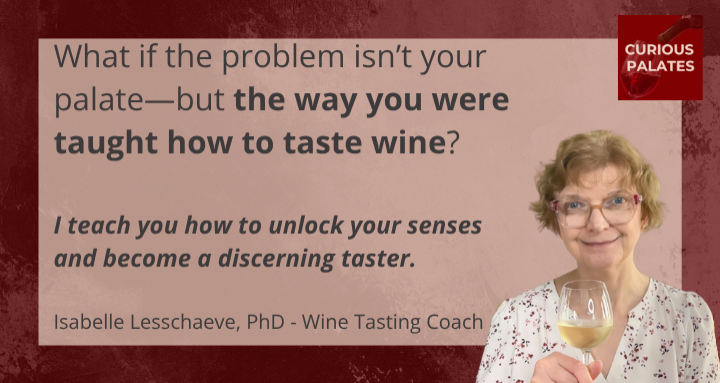
Join Curious Palates, a FREE Community and open training space to develop your wine palate with sensory training

Isabelle Lesschaeve, PhD
Blog author, Wine Sensory Scientist and Wine Tasting Coach
Internationally renowned wine sensory scientist, Isabelle demystifies wine tasting and helps serious wine lovers improve their senses of smell and taste to sharpen their tasting skills and tasting notes.
InnoVinum LLC is a participant in the Amazon Services LLC Associates Program, an affiliate advertising program designed to provide means for sites to earn advertising fees through advertising and linking to amazon.com.