Tasting in the Dark: What Happens When You Take Sight Away from Wine
 Isabelle Lesschaeve
What if the very sense you rely on most to evaluate wine is the one misleading you the most?
We evaluate with our eyes
We experience the world primarily through our eyes.
Don’t we say that our eyes are bigger than our stomach when we tend to overload our plate of food at a buffer?
That’s a French expression at least..
In fact, 85–90% of our daily perception is visual, leaving only 10–15% though the other senses: what we hear, feel, smell, and taste.
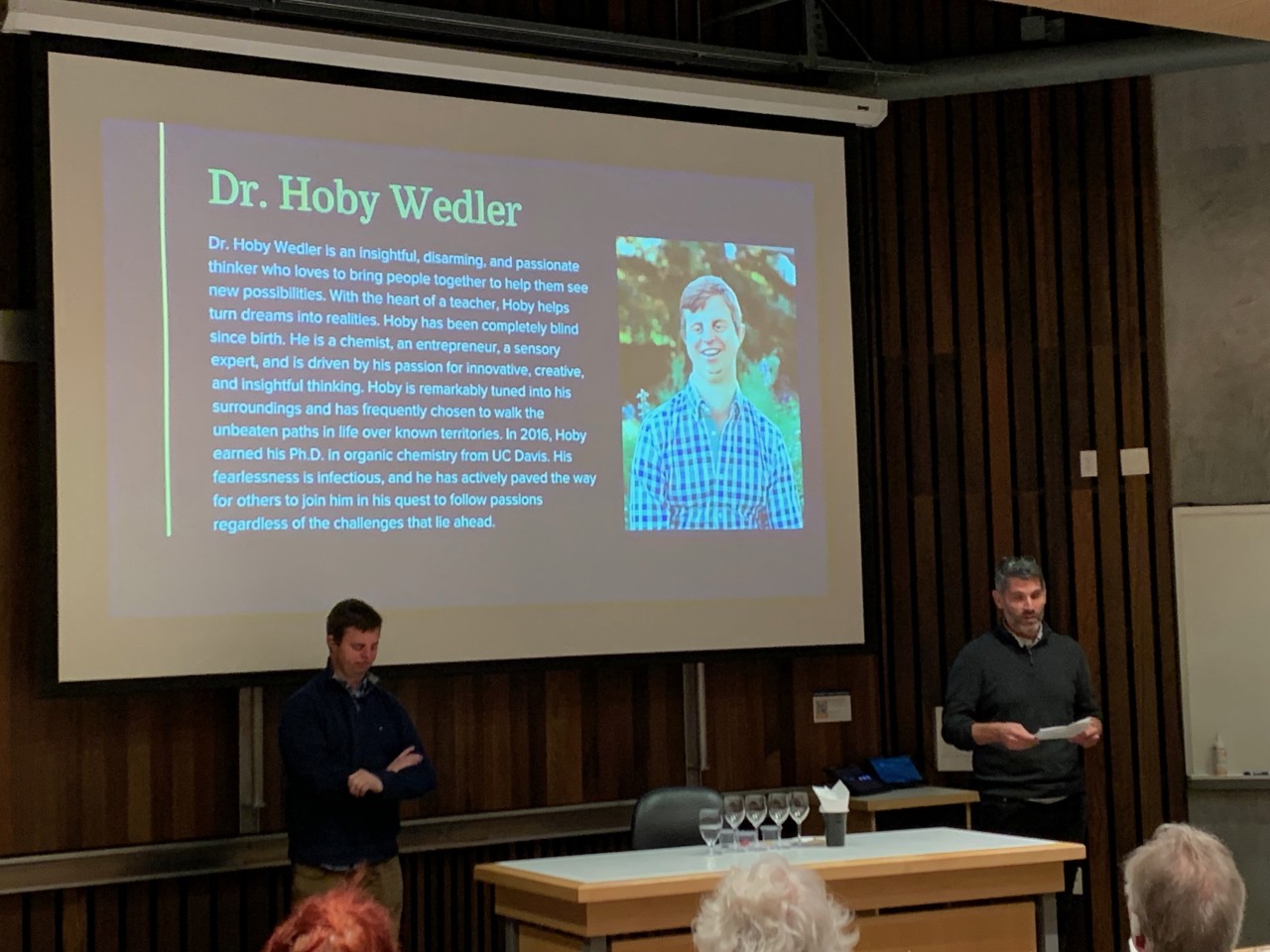
These numbers stopped me in my tracks when I heard it from Dr. Hoby Wedler at an event hosted at the Robert Mondavi Institute, in Davis, CA.
I always teach the insidious influence of vision on wine tasting. I know how powerful it is.
But hearing it quantified so starkly was… quite appalling.
Then Dr. Hoby went further. He explained that smell and taste are our most vulnerable senses—the ones we only engage when we’re confident it’s safe.
Why?
To smell, we must lean in—bend over a fence to smell a flower, bring a glass to our face to sniff.
To taste, we must place something in our mouth, risking irritation (think chili pepper) or unpleasant bitterness.
And yet, these are the very senses that tell us the most comprehensive about each wine we evaluate.
Tasting in the Dark™
The experience I attended was Dr. Hoby’s signature session: Tasting in the Dark™.
Dr. Hoby has been blind from birth and has a very acute sense of smell. He created these tastings so sighted people can experience wine without a single visual cue.
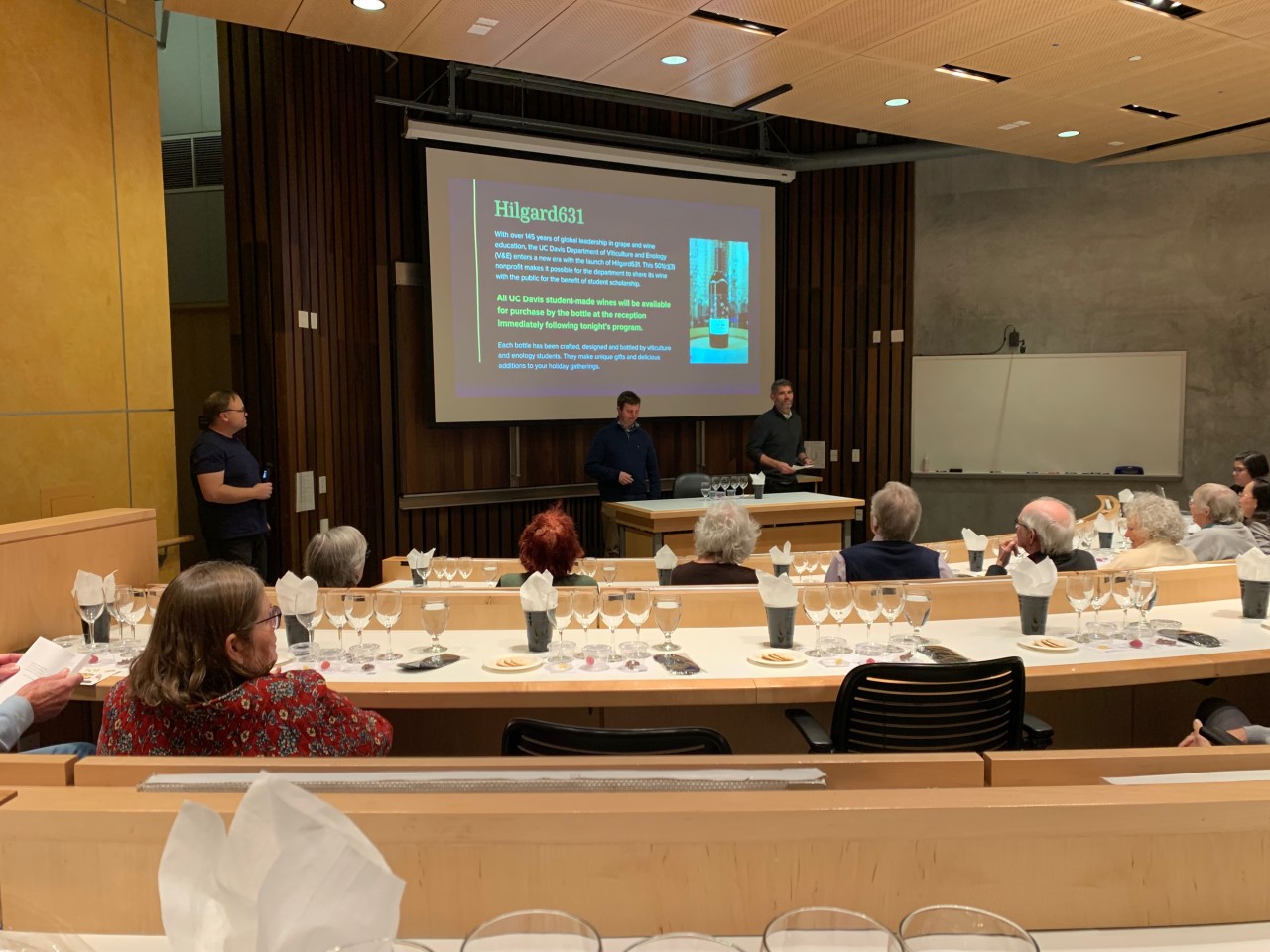
The session took place in the sensory theater of the Mondavi Center—a large, distraction-minimized room designed specifically for sensory work. We tasted four wines made by viticulture and enology students at UC Davis.
Before blindfolding ourselves, Hoby carefully described our setup:
- Four glasses.
- A spit cup.
- Crackers.
- A water glass.
- And three small sealed cups containing aroma references.
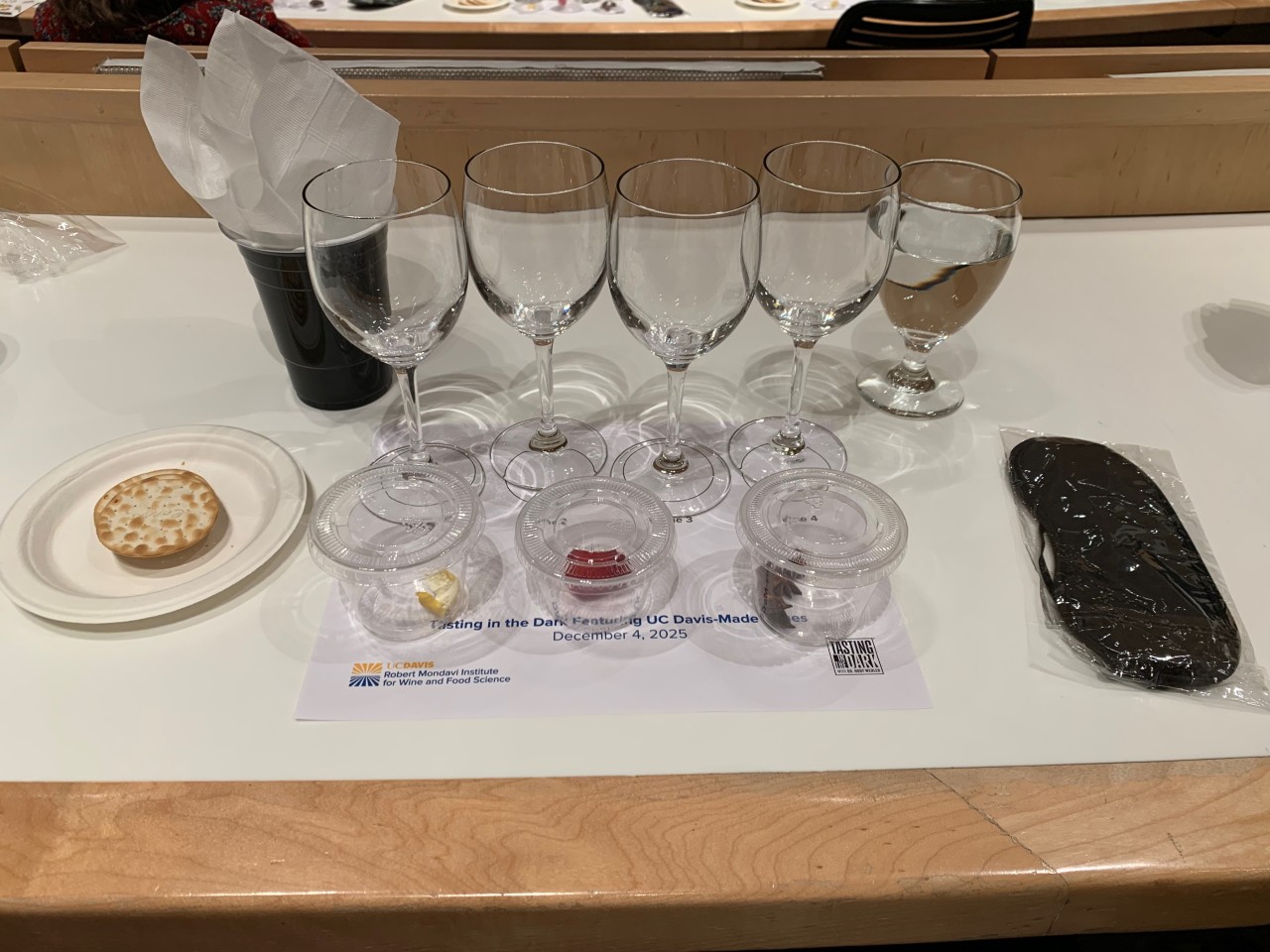
At that moment, the wine glasses were empty. We couldn’t even use color as a clue.
Then we put on the eye masks.
I could hear people giggling nervously. The discomfort was real. We had just lost our dominant sense.
From now on, we would have to rely entirely on smell, taste, sound, and touch.
Listening Without Seeing
As Dr. Hoby spoke, I realized something unexpected:
Listening without seeing the speaker or the projected slides was profoundly different.
No distractions.
No note-taking.
Just pure attention.
While he talked, several students—his “angels,” as he calls them—began pouring wine to all participants. Suddenly, soft aromatic clues floated through the room.
“A fruity white…”
“This one must be a red…”
And then I pulled myself back into listening.
When the lecture ended, we began the tasting—still in the dark.
Finding My Way by Touch
For years, I’ve observed my friend Goran, who is visually impaired, as he navigates a dinner table—extending a flat hand, gently mapping space through touch. I adopted the same movements to locate my samples.
First, we smelled the aroma references.
Dr. Hoby instructed us to shake the sealed cups before opening them. Agitation concentrates aroma compounds in the headspace.
Cup one: lemon — light sound.
Cup two: raspberry — softer sound.
Cup three: aniseed — louder and crisp sound.
Sound, scent, motion—everything suddenly mattered.
The Wines, One by One
As Dr. Hoby guided us to smell and taste the first wine, he encouraged us to shout out our descriptions, what we sensed. Then he asked us to guess the wine style, and revealed it.
Here are my tasting notes.
Wine #1
Bright, lemony aroma with hints of pineapple and tropical fruit.
On the palate: sharply sour.
Voices around the room called it out—Sauvignon Blanc. Correct.
We rinsed with water and crackers. Touching the table, relocating my glass was a humbling experience.
Wine #2
Fruity, slightly earthy nose.
Dry, smooth palate. Cherry emerged clearly.
I guessed Pinot Noir. Yes.
Wine #3
Buttery aroma with a whisper of flint.
Smooth texture. Notes of apple on the palate.
With confidence: Chardonnay.
Wine #4
Fruity nose again—but aggressive tannins, mouth-drying.
I hesitated. Then the room confirmed it: Cabernet Sauvignon.
Not my favorite.
When the Lights Came Back On
When we removed our masks, we were all surprised by the bright theater lights.
Wow, what an inspiring and rewarding experience.
I’ve conducted blind tastings for decades using black glasses or controlled lighting to mask color. But being fully blindfolded while tasting was a first—and far more powerful than I expected.
It stripped wine down to its truth.
If you ever have the chance to attend one of Hoby’s sessions, I wholeheartedly recommend it. Find his information here.
Why Tasting Blind Matters
This experience reinforced what I teach every day:
👉 When you remove visual bias, your other senses get engaged, bringing clarity.
👉 When you slow down and pause, you increase your mindfulness and are ready to assess all the sensations the wine shares with you.
👉 When you trust your nose and palate, your confidence increases and you’re more fair to the wine and its maker.
Trust your senses is what showcase and advocate for inside my community, Curious Palates.
It’s where wine lovers come to:
Develop their senses without being intimidated
Make sensory discoveries in different wine styles
Share their sensory experiences without fear of being “wrong”
And develop true tasting confidence—from the inside out
If this story resonated with you—
- If you’ve ever doubted your nose…
- If you’ve ever relied on the label more than your own senses…
- If you’re ready to taste wine without shortcuts or scripts…
✨ Join us inside Curious Palates.
It’s where sensory perceptions deepen your wine knowledge one wine style at a time.
👉 Come taste differently with us. CLICK HERE TO JOIN

Categories: : Tasting education
Download your Free Resources

Unlock your senses | The Sensory Approach to Wine Tasting
Templates, audio guide to carry out a sensory training
Join Curious Palates, a FREE Community and open training space to develop your wine palate with sensory training

Isabelle Lesschaeve, PhD
Blog author, Wine Sensory Scientist and Wine Tasting Coach
Internationally renowned wine sensory scientist, Isabelle demystifies wine tasting and helps serious wine lovers improve their senses of smell and taste to sharpen their tasting skills and tasting notes.
InnoVinum LLC is a participant in the Amazon Services LLC Associates Program, an affiliate advertising program designed to provide means for sites to earn advertising fees through advertising and linking to amazon.com.